

Introduction
When I first helped a friend launch her bookkeeping side hustle from her kitchen table with exactly $47 in her account, I realized how much bad advice was out there about starting a business. Most guides assume you have savings, a credit line, or at least a laptop you bought recently. Many people don’t. And they still build real, profitable businesses.
Here’s the honest truth: how to start a business with no money is one of the most Googled phrases in America — and the answers most sites give are vague, generic, and borderline useless. This guide is different. I’m going to walk you through the exact steps to start a business with no money, the free tools that actually work, the real mistakes that kill zero-capital businesses early, and the business models built for people who want to start a small business with no money right now.
By the end of this article, you’ll know what business to launch, how to validate it for free, how to land your first client, and how to grow it into something real — without taking on debt or waiting for funding.
Quick Answer: Yes, you can start a business with no money in 2026. The best approach is to launch a service-based business using skills you already have, use free digital tools to operate it, and acquire your first clients through your existing network before spending a single dollar.
What Does It Really Mean to Start a Business With No Money?
Let’s define this properly, because “no money” gets thrown around loosely. Starting a business with no money — or with zero capital — means launching a venture without any significant upfront financial investment. It does not mean the business will never generate costs. It means you deliberately structure your startup to avoid those costs until revenue covers them.
This is different from being underfunded or poorly planned. A zero capital business is a strategic choice. You’re applying the lean startup method: do the minimum to generate the first dollar, then reinvest.
The Three Models That Work With Zero Capital
Not every business can be started for free. But these three models consistently work:
1. Service-Based Businesses You sell your time, skills, or expertise directly to clients. No inventory, no product, no manufacturing. This is the backbone of most no money business launches. Think: freelance writing, virtual assistance, social media management, bookkeeping, tutoring, web design, consulting.
2. Digital Products (Deferred Cost) You create something once — a template, course, ebook, or printable — and sell it repeatedly. The creation cost is your time. Platforms like Gumroad, Etsy (digital downloads), and Teachable have free tiers.
3. Drop-Shipping / Print-on-Demand You list products you don’t own. When someone buys, the supplier ships. Your upfront cost: essentially zero. Margins are tighter, but it’s a legitimate business without funding model for product-minded entrepreneurs.
Why 2026 Is Actually the Best Year to Start With Nothing
According to the U.S. Small Business Administration, over 5.5 million new business applications were filed in 2023 alone — a record, driven largely by people using free digital infrastructure that didn’t exist a decade ago. The cost of starting a business has collapsed. You can build a website, accept payments, send professional invoices, manage clients, and market yourself — all for $0/month using tools available right now.
That’s the real opportunity. The barrier isn’t money anymore. It’s knowing where to start.
What Business Can I Start With No Money? (Best Zero-Capital Ideas for 2026)
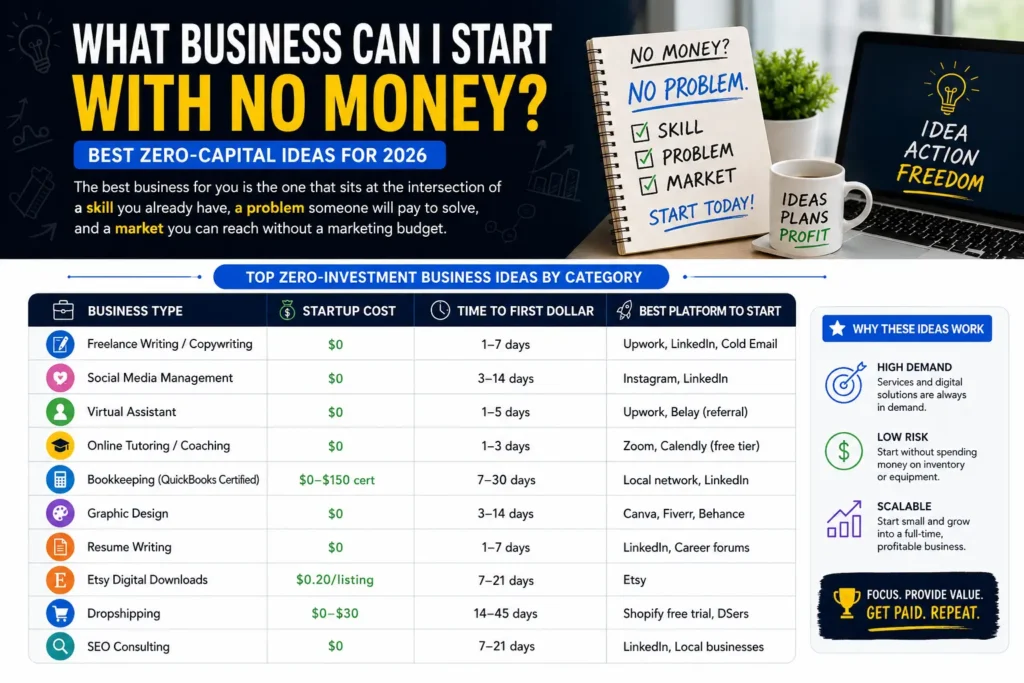
This is the question I get asked constantly. And honestly, the best answer isn’t a list — it’s a framework. The best business for you to start with no money is the one that sits at the intersection of three things: a skill you already have, a problem someone will pay to solve, and a market you can reach without a marketing budget.
That said, here are the small business ideas with no money that I’ve seen work most reliably in 2026:
Top Zero-Investment Business Ideas by Category
| Business Type | Startup Cost | Time to First Dollar | Best Platform to Start |
| Freelance Writing / Copywriting | $0 | 1–7 days | Upwork, LinkedIn, Cold Email |
| Social Media Management | $0 | 3–14 days | Instagram, LinkedIn |
| Virtual Assistant | $0 | 1–5 days | Upwork, Belay (referral) |
| Online Tutoring / Coaching | $0 | 1–3 days | Zoom, Calendly (free tier) |
| Bookkeeping (QuickBooks Certified) | $0–$150 cert | 7–30 days | Local network, LinkedIn |
| Graphic Design | $0 | 3–14 days | Canva, Fiverr, Behance |
| Resume Writing | $0 | 1–7 days | LinkedIn, Career forums |
| Etsy Digital Downloads | $0.20/listing | 7–21 days | Etsy |
| Dropshipping | $0–$30 | 14–45 days | Shopify free trial, DSers |
| SEO Consulting | $0 | 7–21 days | LinkedIn, Local businesses |
From My Experience: The fastest path to a first dollar is almost always a service. I’ve watched people overthink this for months — building a brand, designing a logo, buying a domain — before making a single sale. Don’t do that. Sell first. Brand second.
No Capital Business Ideas Worth Considering in 2026
A few micro business ideas 2026 that are gaining serious traction right now:
- AI Prompt Consultant — Help small businesses use AI tools effectively. Zero investment, high demand, entirely new field.
- Notion Template Creator — Build and sell Notion templates on Gumroad. I know a creator earning $2,000/month from a single template.
- Local Business SEO — Help neighborhood restaurants and shops rank on Google Maps. No ad spend required to deliver results.
- Podcast Show Notes Writer — Growing podcasts need this. You need a Google Doc and Wi-Fi.
- Online Business Manager (OBM) — Manage operations for online entrepreneurs. Pays $50–$100/hour at senior levels.
The thing most people miss: the best business ideas no money 2026 are almost all digital businesses with no investment models. You’re selling time, expertise, or a digital file. None of those require capital.
How to Start a Business With No Money (The Actual Process) Step-by-Step Discuss
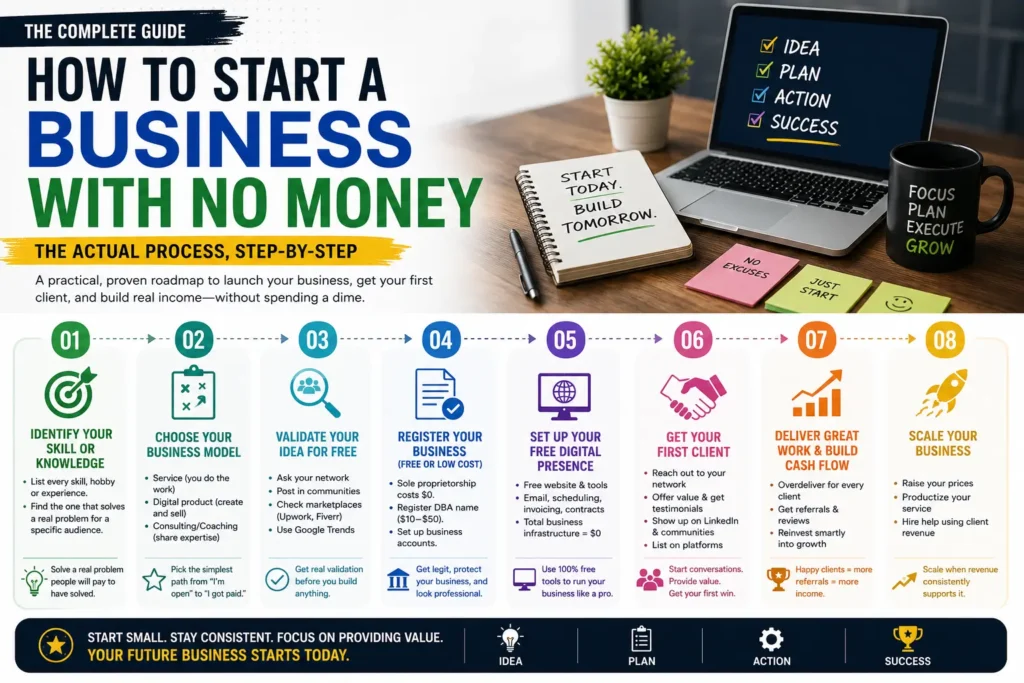
Alright. Here’s the part most articles skip: the exact sequence. Order matters more than people realize. I’ve seen people do step 4 before step 1 and spend six months building something nobody wanted.
Step 1: Identify Your Sellable Skill or Knowledge
Write down every skill you have that someone else would pay for. Include job skills, hobbies, certifications, and life experience. Don’t filter yet — just list.
Then ask: Which of these solve a real, painful problem for a specific type of person?
That’s your starting point. Not a passion. Not a trend. A skill that solves a problem someone will actually pay to fix.
Pro Tip: If you’re stuck, search “[your skill] + freelance” on Upwork and look at what jobs are posted. Real buyers posting real jobs = real demand. That’s your market research, done free in 10 minutes.
Step 2: Choose Your Business Model
Based on your skill, pick the simplest possible structure:
- Service business (most people): You do work, client pays you.
- Digital product: You create once, sell repeatedly.
- Consulting/coaching: You share expertise, client pays for guidance.
Don’t overthink this. The best business model for a startup with no money is the one with the shortest path from “I’m open” to “I got paid.”
Step 3: Validate Your Business Idea for Free
This is the step most people skip — and it’s the most important one. Before you build anything, you need to confirm people will actually pay for your offer.
How to validate a business idea free:
- Post your offer in 3 relevant Facebook or Reddit communities and measure response.
- Message 10 people in your network who fit your ideal customer profile. Describe what you’re offering. Ask if they’d be interested and what they’d pay.
- Search the offer on Fiverr or Upwork — if 50+ active sellers exist, demand is real.
- Use Google Trends (free) to confirm search interest is stable or growing.
You’re looking for this signal: someone says “yes, I’d pay for that” or “I know someone who needs this.” One enthusiastic response beats 100 polite non-commitments.
This is the minimum viable product (MVP) concept applied before you even build the product. Validate, then build.
Step 4: Register Your Business (Free or Near-Free)
You don’t need an LLC on day one. A sole proprietorship costs nothing to operate in most U.S. states. You can register a DBA (“doing business as”) name for $10–$50 in most states, giving you a professional name without the LLC cost.
That said, if you’re doing any client-facing work, read our guide on [LLC vs Sole Proprietorship: Which Is Right for You?] — it matters more than most people think once you start taking real money.
First steps starting a business (legal/admin):
- Register a free Google Business Profile (for local services)
- Open a free business checking account (Relay and Mercury both offer free accounts with no minimums)
- Set up a PayPal Business or Stripe account to accept payments — both free to create, with standard processing fees only on transactions
Step 5: Set Up Your Free Digital Presence
You don’t need a paid website on day one. Here’s a complete how to start a business from home with no money using free tools stack:
- Website: Carrd.co (free tier), Google Sites, or WordPress.com free plan
- Email: Google Workspace (free personal Gmail with your name works at first)
- Scheduling: Calendly free tier
- Contracts: HelloSign free tier (3 docs/month) or free templates from SCORE.org
- Invoicing: Wave (100% free accounting + invoicing)
- Design: Canva free tier
- Video calls: Zoom free (40-min limit) or Google Meet (unlimited free)
- Project management: Trello or Notion free plans
- Social Media Scheduling: Buffer free tier (3 channels)
That’s a complete business infrastructure for $0/month. I’ve run client projects worth $5,000+ using nothing but these tools.
Step 6: Get Your First Client
This is where most guides wave their hands and say “just network!” Here’s what that actually means in practice.
Client acquisition with zero budget:
- Message your existing network first. Send a personal, non-spammy message to 15–20 people explaining what you’re now offering. Not a mass blast — individual messages. This alone generates first clients for a majority of new freelancers.
- Offer one free or discounted project to get a testimonial. Not free forever — one project, in exchange for a written review and permission to share results. This builds social proof without a marketing spend.
- Post on LinkedIn. A simple “I just launched [service], here’s who I help and what I do” post regularly outperforms cold outreach. The algorithm rewards authentic content.
- Join 2–3 online communities where your ideal clients hang out and be genuinely helpful. Answer questions. Don’t pitch. Visibility builds over time.
- List on Upwork or Fiverr for a secondary channel. Don’t rely on it, but having a profile costs nothing and can generate inbound leads.
From My Experience: My first paid client as a content strategist came from a LinkedIn comment I left on someone else’s post. I wasn’t pitching — I was adding value. She messaged me asking if I took clients. That pattern repeats constantly. Be visible, be helpful, be patient.
Step 7: Deliver Exceptional Work and Build Cash Flow
Once you have a client, your job is simple: overdeliver. Not in a way that burns you out, but enough that they refer you, rehire you, or leave a review that brings the next client.
Referrals are the most powerful client acquisition tool for a bootstrapped startup. They cost nothing and convert at dramatically higher rates than cold outreach.
As cash flow starts coming in, keep your reinvestment ratio lean. Use revenue to upgrade only the tools that are actively limiting your growth. Don’t upgrade your website when you need a second client more than you need a new logo.
Step 8: Scale From Solopreneur to Small Business
The solopreneur how to start journey eventually hits a ceiling — your time. When you’re booked solid, you have three paths:
- Raise your prices (often the right first move — most solopreneurs undercharge)
- Productize your service (package it into a fixed-scope, fixed-price offering)
- Hire a subcontractor using client revenue — no capital required
Most bootstrapped startups hit this decision around months 6–18. The key is not to hire before revenue consistently supports it.
How to Monetize Your Skills: Turning Expertise Into Revenue Streams
One of the biggest mistakes I see in the no money start business world is people thinking one income stream equals a business. It doesn’t. It equals a job. A real business has multiple revenue streams — even if they’re small at first.
How to monetize a skill beyond just freelancing:
Revenue Stream 1: Done-For-You Services
Your primary service. You do the work. Highest hourly rate, but limited by time.
Revenue Stream 2: Done-With-You (Coaching/Consulting)
You guide clients through a process instead of doing it for them. Scales better than DFY because you can serve multiple clients simultaneously.
Revenue Stream 3: Digital Products
Create a template, guide, course, or toolkit based on what you already do for clients. Sell it once, earn from it repeatedly. This is a true passive revenue stream — though building it takes active work upfront.
Revenue Stream 4: Affiliate Income
Recommend the tools you already use. Wave, Canva, and dozens of other free tools to start a business have affiliate programs. You earn a commission when someone signs up through your link.
Revenue Stream 5: Group Programs
Teach what you know to multiple clients at once. A $200/month group coaching program with 10 participants generates $2,000/month — the same as coaching 10 individual clients at $200 each, but in a fraction of the time.
Pro Tip: Build revenue stream 1 first. Stabilize it. Then layer in stream 2 or 3 once you have breathing room. Trying to build all five at once is how people burn out before they break even.
Common Mistakes That Kill Zero-Capital Startups Early
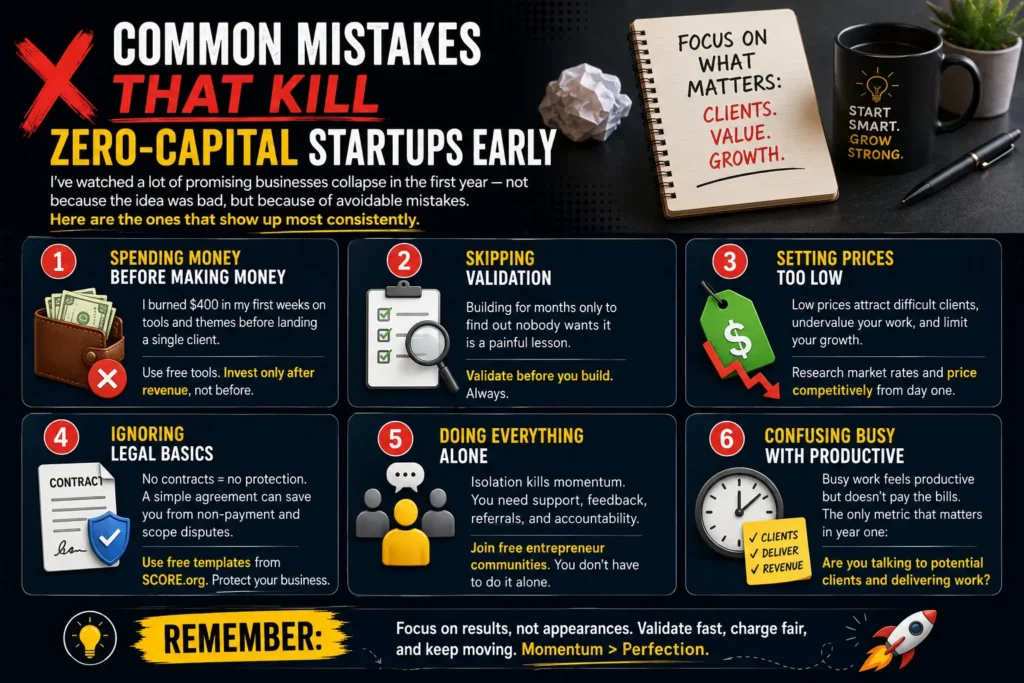
I’ve watched a lot of promising businesses collapse in the first year — not because the idea was bad, but because of avoidable mistakes. Here are the ones that show up most consistently.
Mistake 1: Spending Money Before Making Money
The first time I started a business (a small content agency, back in early 2019), I bought a premium website theme, a project management SaaS subscription, and a professional email suite before I had a single client. Burned through $400 before week three. Not a lot of money, but it was money I didn’t need to spend. Free tools were sufficient for months.
Resist the urge to “look professional” before you are professional. Clients don’t pay for your logo. They pay for results.
Mistake 2: Skipping Validation
Building something for months and then discovering nobody wants it is one of the most demoralizing experiences in entrepreneurship. The lean startup method exists specifically to prevent this. Validate before you build. Always.
Mistake 3: Setting Prices Too Low
Counterintuitive, maybe, but pricing too low actively hurts no capital startups. Low prices attract difficult clients, erode your value perception, and leave you unable to reinvest in growth. Research market rates and price competitively from day one.
Mistake 4: Ignoring Legal Basics
You don’t need a lawyer to start, but you do need basic contracts. A simple service agreement protects you when a client refuses to pay or disputes the scope of work. SCORE.org offers free contract templates. Use them.
Mistake 5: Doing Everything Alone
The freelance to business owner transition is lonely, and that isolation kills momentum. Join a free entrepreneur community — there are hundreds on Reddit, Facebook, and LinkedIn. Accountability partners, feedback, and referrals all come from community.
Mistake 6: Confusing Busy With Productive
In the early months of a startup without money, it’s easy to spend hours on things that feel productive but don’t generate revenue. Designing a logo. Updating your bio. Writing a business plan nobody will read. The only metric that matters in year one: Are you talking to potential clients and delivering work?
Expert Tips! What Actually Moves the Needle for Bootstrapped Startups
I’ve spent years working directly with small business owners, solopreneurs, and early-stage entrepreneurs. Here’s what separates those who break through from those who quit.
1. Start before you’re ready. The “perfect” moment doesn’t exist. Every successful bootstrapped startup I’ve worked with launched imperfect and iterated. The business that exists beats the business that’s almost ready every single time.
2. Treat your first 3 clients like they’re worth $100,000 each. Because they are — in referrals, testimonials, and recurring business. The client acquisition math works like this: one happy client who refers two people who each refer two more is worth exponentially more than any paid ad campaign.
3. The lean startup method isn’t just for tech. Eric Ries wrote The Lean Startup with software companies in mind, but the principles apply directly to service business to start models: build the minimum viable offering, test it with real clients, get feedback, improve. The cycle applies whether you’re launching a SaaS product or a dog-walking business.
4. Cash flow is oxygen. I’ve seen profitable businesses die because of cash flow timing. Invoice immediately on project completion. Offer a discount for upfront payment. Chase late invoices without apology. Positive cash flow keeps a zero capital business alive long enough to grow.
5. Document everything you do. As a solopreneur how to start mindset, this sounds tedious. But every process you document becomes something you can delegate, productize, or automate later. Your future self will thank you.
6. The surprising truth about “free” business models. Here’s the counter-intuitive insight I promised: the cheapest businesses to start are often the most profitable — not despite the low startup cost, but because of it. No capital overhead means your break-even point is essentially zero. Every dollar you make is profit from day one. That’s a structural advantage over funded competitors burning through a runway.
FAQs About How to Start a Business With No Money
What is the easiest business to start with no money?
The easiest business to start with no money is a service-based business using a skill you already have. Freelance writing, virtual assistance, social media management, and online tutoring are all businesses you can launch this week for $0. You need a way to communicate with clients (email or phone), a way to accept payment (PayPal or Venmo), and a skill someone will pay for. That’s it. No website, no LLC, no logo required on day one.
Can I really start a business with $0?
Yes — with important honesty. You can genuinely start many businesses with zero dollars upfront. Service businesses, digital product businesses, and consulting models all have viable $0 entry points. What you will invest is time. Expect to spend 10–20 hours in the first week on setup, outreach, and learning. Some minor costs may appear later (business registration, transaction fees on payments), but none of those are required before you make your first dollar.
What business can I start from home with no money?
The best businesses to start from home with no money include: freelance writing or editing, virtual assistant services, online tutoring or coaching, graphic design (using free Canva), bookkeeping (using free Wave), social media management, resume writing, and selling digital downloads on Etsy. All can be run entirely from a laptop. No storefront, no inventory, no commute. The small business to start at home with no money category is genuinely the largest it’s ever been in 2026.
How do I get my first client with no experience?
Start within your existing network. Message people you already know — former coworkers, friends, family, LinkedIn connections — and tell them specifically what you’re offering and who you help. Offer one discounted or free project in exchange for a testimonial. Then ask that client for one referral. This chain — network → testimonial → referral — generates first clients for the majority of new freelancers and consultants without any marketing budget or prior experience.
What free tools do I need to start a business?
The essential free tool stack for a no money business launch: Wave (invoicing and accounting), Canva (design), Google Workspace or Gmail (email), Calendly free tier (scheduling), Zoom or Google Meet (video calls), Carrd.co or Google Sites (website), Trello or Notion (project management), and Stripe or PayPal Business (payment processing). These free tools to start a business collectively replace thousands of dollars in annual software costs and are sufficient to run a professional service business through your first year.
How long does it take a no-money business to become profitable?
A service-based no money business can become profitable within the first week — literally your first paid client puts you in profit since your overhead is zero. Sustainable profitability (earning a reliable income month over month) typically takes 3–12 months depending on your industry, how aggressively you pursue clients, and your pricing. The SBA reports that businesses with lower startup costs tend to reach break-even faster simply because the bar is lower. Don’t benchmark against venture-backed startups with 18-month runways. Your math is fundamentally different — and better.
The Honest Verdict on Starting a Business With No Money
Here’s what I want you to take away from this guide.
First: the barrier to starting a business has never been lower. Free tools, digital marketplaces, and a connected economy mean that a skilled person with a laptop can build something real without a dollar of startup capital. The ways to start a small business with no money have multiplied significantly in the last five years alone.
Second: the lean startup method isn’t a compromise — it’s a strategy. Bootstrapped businesses that grow slowly from $0 often build stronger foundations than funded ones that grow fast and burn out. You learn what clients actually want. You build habits of resourcefulness. You own 100% of something real.
Third: the hardest part isn’t finding the money. It’s starting before you feel ready, staying consistent through the slow early months, and trusting that first clients lead to second clients lead to a real business.
My honest recommendation? Pick one service you can offer tomorrow. Message five people. Ask if they know anyone who needs it. That’s your business, started, right now.
Ready to go further? Read our guide to [Small Business Grants 2026] — because once you’re up and running, there’s real money available that you don’t have to pay back
About the Author
The Buzzinfo Team includes experienced small business strategists, entrepreneurs, and content specialists with over a decade of combined experience helping founders launch, grow, and scale — often from zero. We write what we’ve lived.View all posts by Buzzinfo Team →
